
Building an e-commerce website in Morocco: payment, delivery and key steps
Selling on Instagram or WhatsApp lets you get started quickly. But as orders grow, the limits appear: messages get lost, stock is hard to track, customers ask for prices one by one. An e-commerce website structures your sales, reassures buyers and makes you visible on Google. It still has to be adapted to buying habits in Morocco. Here are the key steps.
1. Define your model before the technology
Before choosing a tool, answer a few questions. How many products will you sell, and with how many variants (sizes, colours)? Do you deliver throughout Morocco or only in your city? Do you sell to individuals, to businesses, abroad? Do you manage stock or work to order? The answers determine the platform, the payment methods and the logistics.
2. Choose the platform
There are three main options:
- A subscription-based online e-commerce platform (Shopify, YouCan…): quick to launch and simple to manage. Check that the payment methods and delivery services it integrates work in Morocco.
- An e-commerce CMS such as WooCommerce, installed on your hosting: very flexible, with many extensions, provided you take care of updates and security.
- Custom development: relevant for specific needs (customer-specific pricing, a configurator, connection to an ERP) or high volumes.
The right choice depends on your catalogue, your budget and who will manage the website day to day. It is one of the first points we settle with our clients in a website design project.
3. Payment: cash on delivery, card, or both
Cash on delivery
Cash on delivery is still very common in Morocco: many buyers prefer to pay when they receive their parcel, especially for a first purchase on a website they don't know. Offering it removes a major obstacle. Its drawback: refused orders or unreachable customers, which cost delivery fees without generating a sale.
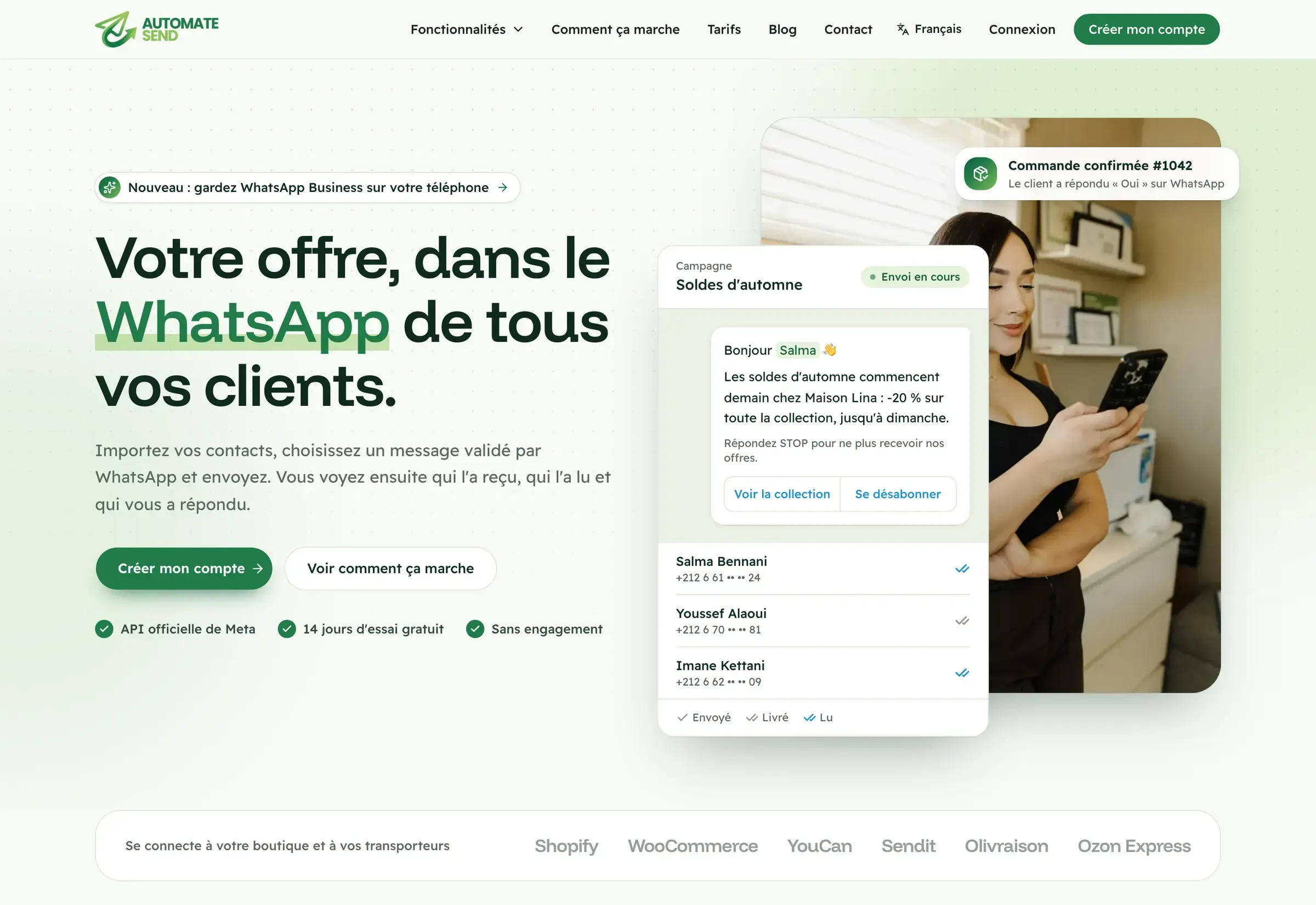
To limit them, many online retailers confirm every order before shipping, by phone or WhatsApp. This confirmation can be largely automated: a WhatsApp message sent as soon as the order is placed lets the customer confirm it, correct their address or cancel. Our article on the WhatsApp chatbot for businesses covers this kind of use in detail.
Card payment
To accept bank cards, you need a payment gateway. In Morocco, the solution from the Centre Monétique Interbancaire (CMI), available through your bank, is the best known; other providers exist. Activation generally involves a contract with the bank, which reviews your website before going live: prepare terms and conditions of sale, a delivery and returns policy, a legal notice and clearly displayed prices.
If you also sell abroad, check that the chosen solution accepts international cards and the currencies you need.
4. Organise delivery and returns
You can deliver yourself in your city, use a delivery company specialising in e-commerce, or combine the two. Compare geographical coverage, lead times, handling of cash on delivery (and how long it takes to pay over the amounts collected), parcel tracking and returns handling.
Display clearly on the website the delivery fees and lead times by area, as well as the conditions for returns or exchanges. An unpleasant surprise at delivery often ends with a refused parcel, or even a negative review.
5. Take care of your product pages
On an e-commerce website, the product page does the salesperson's job. It must answer every question a customer would ask in a shop:
- sharp photos from several angles, on a consistent background, with at least one photo in use;
- a useful description: materials, dimensions, sizes, use, care, what's in the box;
- the price, availability and delivery time visible without searching;
- customer reviews as soon as you have some;
- a WhatsApp button for last-minute questions.
Photos often make the difference between a credible shop and an improvised page. A session in a photo studio produces consistent images for the whole catalogue, reusable on social media and in adverts.
6. Respect the legal framework
An online shop must inform the consumer clearly: the seller's identity, prices, delivery fees, terms of sale and returns. In Morocco, Law 31-08 on consumer protection measures governs distance selling in particular. As soon as you collect personal data (name, phone, address), Law 09-08 also applies: depending on the processing, a declaration or an authorisation request to the CNDP may be required. Have your documents reviewed by a legal professional if in doubt.
7. Prepare customer acquisition from launch
An e-commerce website without visitors doesn't sell. Plan from the start how to attract your first customers:
- Search engine optimisation: categories and product pages designed around your customers' searches, and a website that is fast on mobile.
- Advertising: Facebook, Instagram and Google Ads campaigns to generate sales from the first weeks. Our digital marketing agency designs and runs these campaigns.
- Your social media and your customer list: your followers and existing customers are often your first online buyers.
Install the measurement tools (Google Analytics, Meta pixel, conversion tracking) before launch: they will tell you where sales come from and which campaigns are profitable. For a first campaign on Facebook and Instagram, follow our guide to Facebook and Instagram advertising in Morocco.
Frequently asked questions
Should I offer cash on delivery?
In most sectors, yes, at least at the start: it is the payment method many customers expect. You can combine it with card payment and gradually encourage online payment.
How long does it take to launch an online shop?
It depends on the number of products, the features and the availability of content. Preparing the catalogue (photos, descriptions, prices, variants) often takes longer than the website itself: start early.
Can the shop be linked to Facebook and Instagram?
Yes. Your product catalogue can be imported into Meta's tools to feed adverts that automatically display your products, without entering them a second time.